


The War on Investors’ Minds | Past Wars and Long-Term Market Performance
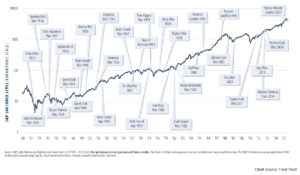
Since the dawn of time, war and conflict have been with us throughout history, bringing with them their own horrors and uncertainty. Stock markets do not like uncertainty, and when war and conflict strike, stock markets will exhibit bouts of short-term volatility. Wars and conflict can and have led to sharp pullbacks in the markets.
Over the long-term, however, the stock market has weathered war and conflict well. The chart LINKED HERE shows this, looking at the historical returns of the S&P 500 Index since 1927 and notating some of the wars and conflicts since. Over the long-term, the S&P 500 has continued to produce positive results.
During times of uncertainty and market volatility it is prudent for plan participants to “stay the course” and it is also prudent for them to review their investment strategies (e.g., “What is my risk tolerance? When will I retire? When will I need this money?”) to ensure they are on the most appropriate path. A new course of action is only warranted if it is more appropriate than the current path. Evaluating one’s own situation—having the most appropriate asset allocation or glide path and a high enough contribution rate—can lead to the most positive actions a participant may take in saving for retirement. Selling out of the markets is typically an imprudent action, often detrimental to reaching future long-term retirement goals. Data indicates that individuals attempting to time the market generally proves futile. Current market conditions rarely provide a clear direction as to the future performance of the markets.
The U.S. market in particular has been dynamic and resilient in moving on from crisis after crisis throughout history. The recent market volatility should remind plan participants to focus on what they should be doing on a regular basis: Be mindful of the situation, but diligent about your investment strategy. Participants need to act in their own best long-term interests while the stock market reacts to the uncertainty surrounding it: another bout of expected short-term market volatility.
For more information on staying the course, contact your financial professional at 1.844.4Lawley.